Spadikam: The Greatest Malayalam Movie of All Time
16 November 2026
Some films become classics. Some become memories. And some become a part of the places and people we call our own. For me, Spadikam is all three.
There are very few films that I can revisit countless times without losing the excitement of watching them. Fewer still are the films that make me appreciate something new every time I watch them.
Spadikam is one such film. In fact, it is much more than that.
Ever since childhood, Spadikam has occupied a special place in my heart. It is one of those movies that I have grown up watching, enjoying, celebrating and revisiting. The dialogues, the characters, the emotions, the action sequences and the sheer entertainment it delivers have always made it special.
But as I grew older, I began appreciating something beyond the entertainment. I started recognising just how remarkably well this film brings together different dimensions of commercial cinema.
Family emotions, drama, romance, humour, action, mass moments, memorable characters and exceptional performances. Spadikam has all of them. And somehow, none of these elements feels out of place.
For me, Spadikam is the greatest Malayalam movie of all time. Not necessarily because it is the most technically sophisticated film ever made, or because it explores the most complicated subject matter, but because it delivers such a complete cinematic experience.
It is one of the finest commercial entertainers Malayalam cinema has ever produced.
And I genuinely believe it is difficult to make a film like this.
A film that has everything
What makes Spadikam so special is its balance.
A film can be emotionally powerful but not particularly entertaining. Another can have spectacular action sequences but very little substance. Some films excel at romance, while others are remembered for their comedy, performances or technical brilliance.
Spadikam somehow brings all these things together.
It is fundamentally a family drama, built around a deeply troubled father-son relationship. But it never limits itself to that one dimension. It takes us through relationships, friendship, conflict, action, and some of the most memorable mass moments in Malayalam cinema.
What I particularly appreciate is how naturally these elements coexist.
The romantic portions don’t feel like interruptions to the main story. The humour doesn’t undermine the emotional drama. The action doesn’t feel disconnected from the characters. And the mass moments aren’t inserted merely to generate applause.
Everything contributes to the larger experience.
There is a certain completeness to Spadikam that I find incredibly difficult to explain. When the film ends, I don’t find myself wishing that it had included something more. It has already taken me through almost every emotion and cinematic experience I could ask for.
That, to me, is the definition of an exceptional commercial entertainer.
Aadu Thoma: More than just a mass character
It is impossible to discuss Spadikam without discussing Thomas Chacko, better known as Aadu Thoma.
Mohanlal’s portrayal of this character is one of the most remarkable performances in Malayalam cinema.
Aadu Thoma has an attitude, a swagger and a screen presence that are difficult to replicate. His body language, expressions, dialogues and the way he carries himself make him instantly recognisable.
But reducing Aadu Thoma to a mass character would be doing the film a disservice.
There is much more to him.
He is a rebellious individual who refuses to conform to expectations. He is a son who carries the emotional scars of a difficult childhood. He is a lover, a friend and a man with his own vulnerabilities. Beneath the intimidating personality is someone who has experienced rejection, disappointment and a deep desire to be understood.
This contrast is what makes the character so fascinating.
Mohanlal moves between these different shades with extraordinary ease. He can make you laugh with a casual expression, give you goosebumps with a dialogue delivery and make you feel the pain of a character who has spent years carrying emotional baggage.
The performance never feels like an actor trying to demonstrate how powerful a character is. It feels like someone completely inhabiting that character.
And that is the difference.
Aadu Thoma doesn’t need to constantly prove that he is a larger-than-life personality. His presence does that for him.
The emotional heart of Spadikam: Chacko Master and his son
If Aadu Thoma is the soul of the film’s entertainment, the relationship between Thomas Chacko and his father is its emotional foundation.
Chacko Master, played brilliantly by Thilakan, is one of the most important characters in the film.
He represents a particular kind of parental authority, one that measures a child’s worth through academic performance, discipline and conformity. His expectations of his son become so overwhelming that he fails to recognise the individual standing right in front of him.
Thomas is intelligent, capable and independent-minded. But his father cannot see beyond his academic shortcomings.
The tragedy is not simply that a father and son have different personalities. It is that the person whose acceptance matters most to Thomas is also the person who fails to understand him.
This conflict shapes Thomas’s life and eventually contributes to the person he becomes.
What makes this storyline so powerful is that it is deeply human. It explores parenting, ego, expectations, generational differences and the consequences of failing to understand someone you love.
The film could have easily presented this as a conventional story about a rebellious son. Instead, it gives us a much more complicated emotional conflict.
And Thilakan’s performance is absolutely central to making it work.
His portrayal of Chacko Master is commanding, intimidating and deeply convincing. He creates a character who can frustrate you, anger you and, eventually, make you reflect on the damage that misplaced expectations can cause.
The chemistry and dramatic tension between Mohanlal and Thilakan elevate the film considerably.
You need two extraordinary performances to create a conflict this memorable. Spadikam has them.
Bhadran’s understanding of commercial cinema
A significant part of what makes Spadikam work is Bhadran’s filmmaking.
It is one thing to have an excellent story and talented actors. It is another to bring together so many different elements and make them feel like one cohesive film.
That is where Bhadran deserves enormous credit.
His story and screenplay establish a strong emotional foundation, while leaving plenty of room for the film to be entertaining, dramatic and spectacular.
The pacing is particularly important. The film knows when to build tension, when to let a scene breathe and when to deliver a moment that stays with the audience.
Its characters are not simply devices to move the protagonist’s story forward. They have their own identities, relationships and motivations.
This gives the film a sense of completeness. It feels like an actual world populated by memorable people rather than a story constructed solely around its leading actor.
I also appreciate how the film doesn’t seem confused about its identity.
It knows that it is a commercial entertainer, but it never treats that as an excuse to compromise its emotional storytelling.
It is confident in being entertaining and equally confident in being emotionally powerful.
That combination is one of Bhadran’s greatest achievements with Spadikam.
An ensemble that makes the film even better
While Mohanlal and Thilakan understandably receive much of the attention, Spadikam benefits enormously from its supporting cast.
Urvashi brings warmth and personality to Thulasi. KPAC Lalitha adds an important emotional dimension as Mary. Nedumudi Venu, Rajan P. Dev, Spadikam George, Ashokan, Maniyanpilla Raju and the rest of the cast contribute to making the film’s world feel complete.
Each character has a place in the narrative.
The supporting performances also help establish the atmosphere of the film. There is conflict, affection, tension, and personality throughout the ensemble.
A film with a great protagonist is wonderful. A film in which the people surrounding that protagonist are equally memorable is something else.
Spadikam gets this right.
The filmmaking: Music, visuals and atmosphere
Another reason I consider Spadikam such a complete experience is the contribution of its technical departments.
The cinematography gives the film a visual identity that complements its setting and characters.
The locations don’t feel like generic backgrounds for a story. They contribute to the atmosphere and make the film’s world feel recognisable and lived in.
The editing helps maintain the narrative rhythm, allowing the film to transition between its different emotional and entertainment-driven sequences.
And then there is the music.
S. P. Venkatesh’s compositions, combined with P. Bhaskaran’s lyrics and the film’s performances, give Spadikam another dimension.
The songs, including Ezhimala Poonchola and Ormakal, are an integral part of the film’s identity. They contribute to its romance, nostalgia and emotional atmosphere.
The background score also plays an important role in enhancing the film’s dramatic and action sequences.
These elements may not always be the first things people mention when discussing Spadikam, but they are essential to why the entire experience works so well.
A commercial entertainer is the result of many departments working together. Spadikam is a wonderful example of that collaboration.
The mass moments are earned
Let’s be honest. A significant part of the joy of watching Spadikam comes from Aadu Thoma’s mass moments.
The attitude, the confrontations, the dialogues, the action sequences, and Mohanlal’s screen presence make the film an absolute celebration.
But what makes these moments particularly satisfying is that they are earned through the story.
By the time Aadu Thoma delivers an iconic dialogue or gets into a confrontation, we already understand his personality, his circumstances and the experiences that shaped him.
The mass moments are therefore extensions of the character rather than isolated attractions.
There is also a wonderful sense of humour in the way Aadu Thoma carries himself. His confidence, mischievousness and unconventional behaviour make him entertaining even when he isn’t involved in an action sequence.
That is the magic of the character.
He doesn’t need a fight scene to be interesting. Sometimes, simply watching him interact with another character is entertainment enough.
And when the film finally delivers those larger-than-life moments, they feel even more satisfying.
Changanaserry Market: A personal connection to the world of Spadikam
There is another reason why Spadikam holds an especially personal place in my heart.
Changanaserry Market, which happens to be in my hometown, is one of the locations associated with the film. Much of the film was shot around this market.
This gives me a connection to the film that goes beyond simply being an admirer of its characters and storytelling.
Whenever I visit my hometown, I experience a certain nostalgia associated with Spadikam. Knowing that Changanaserry Market was part of the cinematic world of Aadu Thoma makes the film feel a little closer to me.
It is a rather wonderful feeling.
For most people, watching Spadikam means revisiting a memorable Malayalam movie. For me, it also brings to mind a place that I associate with home, familiarity, and childhood memories.
Cinema has this beautiful ability to give places an entirely different meaning.
A street, a market, or a familiar building can become special because of the memories associated with a film. And when that film happens to be one you have loved since childhood, the connection becomes even more meaningful.
I don’t think I will ever be able to visit Changanaserry Market without having Spadikam somewhere in the back of my mind.
Aadu Thoma is a fictional character, of course. But knowing that the world he inhabited was brought to life in a place so close to home makes the experience of watching the film that much more special.
It is a connection I genuinely cherish.
Two shots I’ll never get tired of
There are certain moments in Spadikam that stay with me long after the film ends.
Among them are two particular frames that I find especially memorable.

The iconic lorry nameboard with the vulture spreading its wings above it. A striking visual that captures the film’s identity in a single frame.
Aadu Thoma
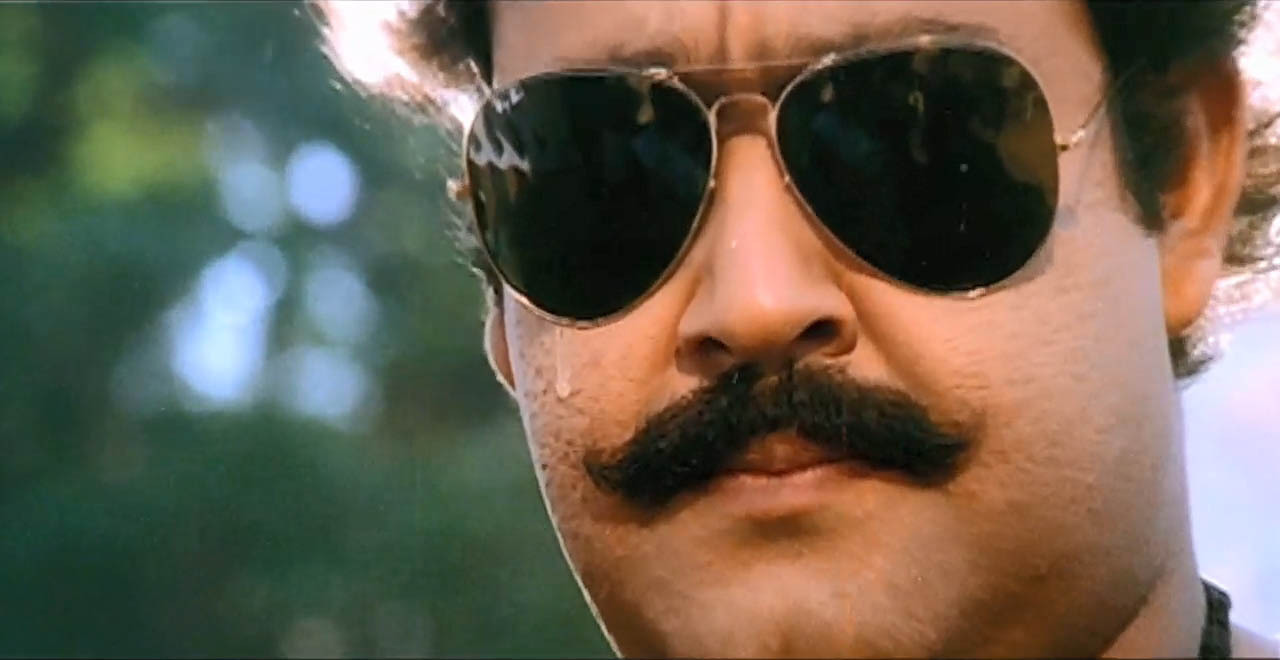
A close-up of Aadu Thoma wearing his sunglasses while tears are running down. There is something about that expression, the moustache, the attitude and the sheer screen presence that makes this frame instantly recognisable.
Both images represent different aspects of what makes the film so special: its distinctive cinematic identity and the unforgettable character at its centre.
Sometimes a single frame is enough to bring back an entire film.
These are two frames I could look at repeatedly without getting tired of them.
Why Spadikam continues to feel special
Spadikam was released in 1995. Yet its entertainment value, characters, and memorable moments continue to resonate with audiences.
I think that comes down to something fundamental: the film is not dependent on just one aspect of its appeal.
It isn’t remembered only for Aadu Thoma’s dialogues or Mohanlal’s performance. It isn’t remembered only for its action sequences or its emotional father-son conflict.
It is remembered for the entire experience.
You can revisit it for the entertainment, the performances, the romance, the music, the drama, or simply the pleasure of watching these characters come alive again.
And each time, there is something to enjoy.
There are many wonderful films in Malayalam cinema, each with its own strengths and contributions. But when I think about a film that brings together so many elements of commercial cinema without losing its emotional identity, Spadikam remains my first choice.
It doesn’t need to be perfect in every technical or artistic dimension to be exceptional. Its greatness lies in how beautifully all its different dimensions come together.
The final word
I have loved Spadikam since childhood. And even after all these years, I haven’t grown tired of it.
If anything, my appreciation for the film has only increased.
As a child, I loved the characters, the dialogues, the action, and the sheer entertainment. As I grew older, I began appreciating the screenplay, the performances, the direction, and the emotional depth that hold everything together.
With Changanaserry being my hometown, the film carries an additional personal meaning.
Perhaps that is what makes certain movies truly special. They become more than something we watch on a screen. They become part of our memories, our conversations, and sometimes even our connection to the places we call home.
There are films that make you think. Films that make you cry. Films that make you laugh. Films that give you goosebumps.
Spadikam does all of these things.
It is a family drama, an emotional journey, an action entertainer, and a celebration of everything that makes commercial cinema enjoyable.
For me, it is the complete package.
And if someone asks me which Malayalam movie I would choose as the greatest of all time, my answer remains the same.
Spadikam. Without a second thought.
Aadu Thoma is one of a kind. And so is this film.